


|
|
|---|
|
|
|---|
Our Dental ServicesAt Next Door Dental, we provide a wide range of services to meet the many needs of our patients. And over the course of a lifetime, the needs of your teeth will change with age, illness, accident, and various other reasons. We understand that there is sometimes apprehension about visiting the dentist, but you have our promise that we will always greet you with a smile and give you and your loved ones the absolute best dental care available. Trust Next Door Dental to keep your family smiling. |
 Every six months, patients should be examined to ensure that teeth and gums are healthy and free of disease and decay. Plaque and tartar are removed, careful flossing removes hidden dangers, and all of the teeth are polished to a squeaky clean, smooth finish.
 Fillings are done to remove decay and replace the affected tooth structure. It is called a filling because new material fills the hole that decay left. Now days, most teeth are treated with bonded tooth-colored composite resin fillings. Caught early enough, cavities can be treated easily and painlessly, but if not treated, decay can lead to tooth pain and/or infection, and the tooth may then need root canal treatment or extraction.
 Sometimes, there is no alternative but to remove teeth. Wisdom teeth can become impacted or create other space-related issues, and are a common reason for extraction. Disease, accidents, and neglect may also lead to necessitating taking out a tooth. This is done under local anesthesia and is generally routine in nature.
 Bonding involves adhering composite resin material (matched to the color of the tooth) to the front of the tooth. This is done to repair damage done by decay, to alter the alignment of the tooth, to close gaps between the teeth, or for cosmetic purposes. First, the surface of the tooth is roughened in order to accept the bonding material. A gel is then applied to micro-etch the tooth surface, and a primer/bond agent is applied so the bonding material adheres to the surface. Then the material itself is placed on the tooth and is hardened with a special light. Finally, the composite resin material is shaped and polished to get a lustrous finish.
 Sealants are used to fill in narrow grooves in a tooth that cannot be adequately cleaned by brushing. In some cases, the tooth structure has fine grooves or pits which accumulate plaque. This is not because the person doesn't brush, but because the gap is too narrow to allow even one bristle into them. These can develop cavities over time, so the dentist applies a coating that seals the grooves and pits, making it possible to brush off all the plaque and keep your teeth healthy.
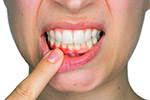 The gums, ligaments, and bone around the teeth form the foundation for ones teeth. Collectively, this is also referred to as the periodontium. When the periodontium is not healthy, it jeopardizes the teeth, just as a bad foundation would threaten the stability of a house. Signs of unhealthy periodontium (or gum disease) may be as follows: gums that are red and bleed easily, persistent bad breath, gums that are pulled away from the tooth, loose teeth, and changes in the position or bite of the teeth. Any of these may be signs that something is going wrong. With the proper care, however, it may be possible to return them to a healthy state. If you're having any of these problems, come in and see us so we can take care of it right away. The treatment usually involves a deep cleaning or even a root planing, done under a local anesthetic along with local antibiotic agents. If the gum disease gets too severe due to lack of attention, it may need to be treated surgically, so don't delay at the first sign of a problem.
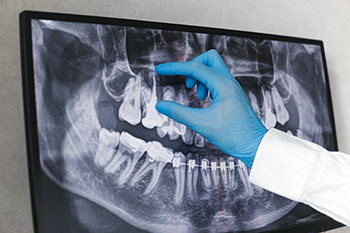
 A focused beam of X-Ray particles through bone produces an image on special film, which shows the solid structure through which it passed. This gives the familiar black and white images that doctors and dentists use to diagnose problems. X-rays are a necessary part of the diagnostic process, and not to use them could lead to undiagnosed disease. Without an X-ray of the whole tooth and supporting bone and gum tissues, there is no real way to detect infection or pathology that requires attention.
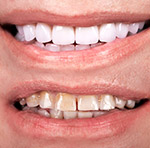 Cosmetic suggests anything done to correct imperfections in the appearance of the mouth, even if it is not a threat to your health. Basically, anyone who is unhappy with their smile can have it fixed. Typically the upper teeth show only when smiling, while the lower teeth remain hidden. This is reversed when talking, with the upper teeth remaining hidden while the lower teeth show. The color, alignment, and spacing, as well as regularity of the teeth are the characteristics that contribute to the mouth's overall appearance. Any of these can be repaired or altered to give a more pleasing look to your mouth. As such, we offer a wide variety of cosmetic options.
 Age, diet, and genetics contribute to the gradual staining and yellowing of teeth. We have procedure for making teeth whiter and more attractive, and it's guaranteed to boost your self-confidence.
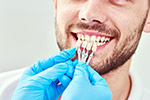 A procedure in which a covering is placed over the outside (or visible area) of the tooth, veneers are typically applied only to the part of the tooth that is visible when talking or smiling. The direct technique, commonly called bonding, usually involves placing composite resin on the outside of the tooth using a bonding material.
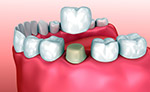 Crowns are full coverage restorations that are used to cover a tooth that is likely to break, or is too broken down to be restored with a filling. They are commonly done after root canal treatment or when a large filling wears out. The larger the hole made by a cavity, the more likely a crown will be needed. Even after a filling is put in a large cavity, a tooth is more likely to break.
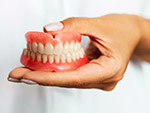 There are different types of dentures, but they share a common function: they replace teeth that have become loose or been lost due to bone loss, disease, or accident. When bone loss around the roots of teeth is great enough to loosen them or let them fall out, it's time for dentures. Relax; while no one enjoys losing their natural teeth, you can still eat and talk and have a great looking smile.
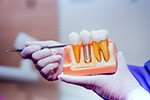 A dental implant is one option to replace a missing tooth. In this procedure, a small titanium post is surgically implanted into the bone and allowed to set. The bone grows around it, forming a tight connection, which additionally slows or stops the bone loss that occurs when the root of a natural tooth is missing. Once the implant is firmly set in the mouth, the dentist then works to attach the replacement tooth onto the top of the post. This permanent solution has the advantage over bridge work that it does not stress the surrounding teeth for support, and, should the tooth wear out, another can simply be replaced on the existing post.
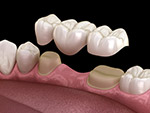 This is sometimes an option for filling the space created by a missing tooth, and is formed to look like the missing tooth it is replacing. The sides of a bridge use the two surrounding teeth for support, hence the name. Since a bridge replaces the missing tooth both functionally and cosmetically, bridge work is as much an art as it is an exact science. The materials used may be gold alloys, porcelain bonded to metal alloy, or all ceramic material, depending on requirements for strength, wear, and aesthetics.
 |
|
|